

Executive Summary
Generative AI has moved out of the chat window. The current generation of agentic tools, including Claude Cowork, Google Antigravity, and OpenAI Codex, can read entire folders of material, operate applications, and carry out multi-step work with limited supervision. Used well, they compress days of work into hours; controlled studies have found professionals completing writing tasks roughly 40% faster [1] and developers finishing coding tasks more than 50% faster [2]. Used carelessly, they produce polished, confident output that is wrong. The difference lies almost entirely in how the work is framed, what context the tool is given, and how the output is reviewed.
This paper sets out a practical framework in six parts:
Frame every task as a journey. Know where you are, where you are going, and how to get there, and give the tool concrete examples of the endpoints whenever possible.
Separate deterministic from non-deterministic work. Ask AI to perform non-deterministic work directly. For deterministic work, ask it to build the formulas, spreadsheets, or code that will run the process instead.
Curate context. Provide the minimum context necessary to get the job done, increasingly delivered as a folder the agent can read on its own.
Match the model to the complexity. Simple questions run well on inexpensive models; open-ended, context-heavy questions require more capable and more costly ones.
Respect data boundaries. Company, client, and personal information belongs only in approved enterprise instances, and AI-assisted work stays inside existing review controls.
Manage variability. Combine adversarial checking, multi-model orchestration, and a disciplined human review. A human reviewer remains mandatory for anything requiring judgment.
The paper closes with guidance on publishing prototypes and on the hands-on work sessions where teams apply these practices to their own workflows.
1. The Agentic Shift
Until recently, working with generative AI meant pasting information into a chat window and copying the answer back out. The burden of gathering context sat entirely with the user, and the practical ceiling on how much context could be provided was low. Through early 2026, this was the central limitation of the technology in everyday use.
Agentic tools remove much of that burden. Claude Cowork brings agentic file and task management to the desktop for people who do not write code. Google Antigravity orchestrates autonomous agents across an editor, a terminal, and a browser. OpenAI Codex embeds an agent in ChatGPT and developer tools that can plan, execute, and verify multi-step tasks. Rather than waiting for pasted text, these tools ingest entire folders of information in varying formats, from documents and spreadsheets to data extracts, images, and video, and work across all of it.
Folder as context: The most effective way to brief an agentic tool is a clean folder: the inputs you normally receive, examples of the outputs you expect, and nothing else.
2. Start with the Journey
Before opening any AI tool, understand what you are using it for. These tools excel at non-deterministic work at specific points in a process, and the clearest way to frame that work is a navigation analogy.
When you open Google Maps, you supply three things. You confirm where you are. You enter where you are going. You choose how to travel: driving, walking, or transit. With those three anchors the app produces a route. Remove any one of them and no route is possible. Every AI task has the same three anchors:
Where you are. Your current materials: the draft, the data, the source files, the history.
Where you are going. A concrete picture of the desired end state, ideally an actual example of the output you want replicated.
How to get there. The process, the tool, and the model that carry you between the two.
AI can assist with any of the three. It performs best when you can show it examples of the endpoints and tell it what stage each example represents.

Figure 1. Every AI task has the same three anchors as a navigation app.
2.1 A hiring example
Suppose a friend was hired at a company you are targeting, and you have the resume that got them there. That resume is the destination. Your current resume, together with the posting for the job you want, is where you are; it carries all of your context. Give an AI both, and it will produce a resume in the style and structure of your friend’s, built entirely from your own information, far faster than you could produce it yourself. A human review still follows, and you iterate from there. The AI managed the route; you supplied both endpoints.
2.2 A finance example
Now imagine a recurring finance process. You know the inputs you receive each period and the outputs you have produced historically. That history is ideal material: provide last period’s inputs and outputs as the worked example, provide this period’s new inputs, and ask the tool to replicate the process. One refinement matters. Where parts of the process are deterministic, meaning the same inputs must always yield the same outputs, have the AI design formulas, an Excel workbook, or code to run those parts rather than asking it to produce the numbers directly. Section 3 explains why.
2.3 Working in reverse
The journey also runs backward. If you have a finished model and you understand the process that produced it, you can ask AI to reconstruct the source documents: test data, inputs, templates, or documentation. Reverse engineering is often the fastest way to build training materials and test cases for an existing process.
2.4 When you have no destination
If you do not yet know where you want to go, AI is a capable brainstorming partner for exploring destinations. Use it to generate options, pressure-test assumptions, and map trade-offs. The more judgment a decision requires, the more risk there is in delegating it. In a field experiment with 758 BCG consultants, AI assistance raised speed and quality substantially on tasks within the model’s competence, yet on tasks just beyond that frontier, consultants who relied on the AI were 19% more likely to reach the wrong answer [3]. Domain experts remain better at determining the best endpoint. Let AI widen the option set; let experts choose the destination.
3. Deterministic and Non-Deterministic Work
A deterministic process produces the same output from the same input every time. Tax tables, amortization schedules, journal-entry mappings, and reconciliations all behave this way: given identical inputs, there is exactly one correct answer. A non-deterministic process has many acceptable outputs. Drafting a memo, summarizing a meeting, structuring a resume, and naming a product can each be done well in many different ways.
Generative AI models are non-deterministic by construction. They predict the next word; if they are run twice on the same prompt, they will phrase things differently, structure things differently, and may reach different conclusions. This makes them a natural fit for non-deterministic work and a poor engine for deterministic work. Asking a language model to calculate a depreciation schedule asks for a probabilistic system to imitate arithmetic. It might be right, and “might” is a standard no controller accepts.
However, AI-use excels when it either (1) performs the non-deterministic work or (2) is used to build the code and logic for the deterministic work. When a workflow reaches a deterministic component, ask the AI to write the formula, generate the spreadsheet, or produce the code. The artifact it builds then runs deterministically every time, and it can be validated once instead of re-verified on every use.
4. The Complexity Spectrum and Model Selection
Both kinds of work sit on a spectrum of complexity, and the spectrum tells you how much machinery, or how much model, a task needs.
Deterministic questions range from trivial to intricate. One plus one equals two requires nothing. A tiered revenue allocation with hundreds of branching conditions requires deeply nested logic, engineered formulas, or code. Most software is solely increasingly complex deterministic logic.
Non-deterministic questions scale the same way. Ask what color the sky is on a cloudless day and nearly any model answers “blue”. Yet even that simple question hides ambiguity: the asker may be colorblind, may live somewhere the sky rarely looks blue, or may be asking at night. No formula resolves it; the model predicts the most likely answer from context. Scale the question up, to how a resume should be formatted or how a nascent product should be positioned in an emerging market, and the task demands far more sophisticated models with larger context windows and stronger reasoning.
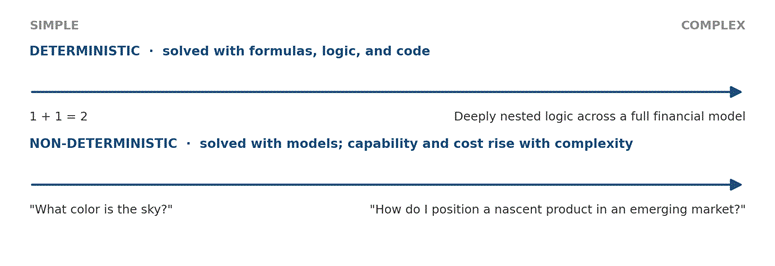
Figure 2. Complexity scales the same way in both worlds. Deterministic complexity is bought with engineering; non-deterministic complexity is bought with model capability.
Just as complex deterministic answers require more elaborate formulas and logic, complex non-deterministic answers require more capable models. Capable models that ingest more context also cost more. The discipline is matching the model to the task rather than defaulting to the most expensive option.
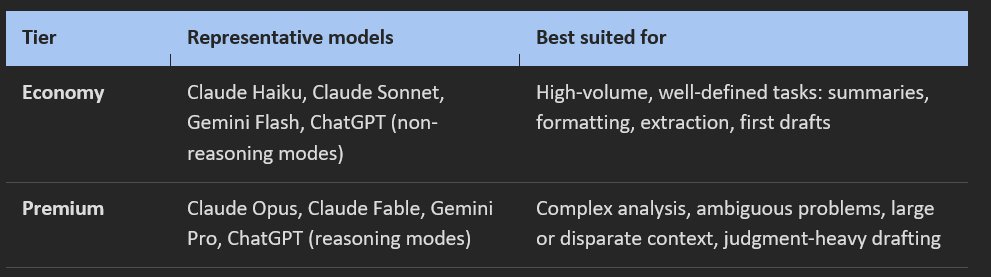
Table 1. Current model tiers, from least to most expensive.
Run routine, well-specified work on the economy tier, and reserve premium models for tasks with heavy context, ambiguity, or high stakes.
5. Context Is the Fuel of Every Task
Every stage of the journey shares one requirement: context. Context is all the relevant information, facts, circumstances, and data you feed the AI so it can produce reasonable output.
A best practice is to provide only the context relevant to the scenario: the input files you normally receive, examples of the output you want, and whatever happens in between. In practice, most context is messy. A journal-entry extract carries far more than the fields your close analysis needs. A complete job history contains far more than a targeted resume needs. Oversupplying scattered information confuses models, and the research confirms it: model accuracy degrades measurably when relevant information sits buried in long contexts, with models attending most reliably to material near the beginning and end of what they are given [4]. The more context you provide, and the more disparate it is, the more advanced and expensive the model you need, on top of whatever complexity the problem itself carries.
Use the minimum context necessary to get the job done. A resume does not require your full life story. This month’s reporting package does not require financials from seven years ago. Before granting an agent a folder, curate the folder.
Minimum context necessary: Give the tool exactly what the task needs and leave the rest out. Every irrelevant file added to the folder makes the output less reliable and the run more expensive.
6. Skills: Packaging Workflows for Repeatability
One more piece completes the toolkit: skills. In Claude, a skill is a packaged set of prompts, instructions, and connectors that encodes a repeatable process. Anthropic builds many of these with top practitioners in each field, so a skill functions as an expert’s workflow you can invoke on demand and rely on for consistent output. Skills that have proven consistently useful in practice include dashboard generation, process walkthroughs, and financial statement preparation, and the library extends well beyond these.
The more powerful move is building your own. Once you have run a workflow successfully a few times, capture it. Where earlier generations of automation captured logic in formulas, agentic tools capture it in skills: the instructions you supply beyond the files themselves, covering what to accomplish and how, plus any connectors to other systems the process must talk to. A well-built skill turns a one-off success into a reliable, repeatable output, and it produces finished deliverables directly, whether PowerPoint decks, Word documents, or Excel workbooks.
7. Connectors: Powerful in Theory, Limited in Practice
Connectors deserve an honest assessment. Nearly every vendor now offers live integrations that plug an AI directly into systems such as NetSuite, Salesforce, or SharePoint. In practice today, they are often more limited than the marketing suggests, for exactly the reasons covered in Section 5.
The moment an AI is connected to a full instance of a complex system, it is drowning in context. Point a model at an entire ERP, or at a person’s complete history down to every report card and grade, and it has no reliable way to know which records matter. Even when it tries, scrubbing through everything takes enormous effort and yields unreliable results.
Today, the dependable pattern is usually to skip the live connection: run the report you need in the source system, download it, and feed the file to the AI. A targeted export is pre-curated context; it embodies the minimum-context principle automatically. Connectors continue to improve, and narrowly scoped ones already work well; as their design matures, this calculus will likely change. For now, when in doubt, download the report.
8. Managing Non-Determinism: Orchestration and Review
8.1 Why outputs vary
Because models are non-deterministic, the same prompt produces different output every time, and no amount of spending removes this completely. Fine-tuning, an expensive process most companies sensibly avoid, shapes a model’s style and consistency, but the variability inherent in how these systems generate text remains. True repeatability comes from only one place: moving the deterministic parts of the work into formulas and code, as Section 3 describes. For everything else, variability must be managed in the workflow. Three layers accomplish this: adversarial checking, multi-model orchestration, and human review.
8.2 Adversarial checking
Before any human review, have a separate AI instance attack the work. Suppose Claude produced a report you like. Open a fresh instance and instruct it: “You are acting as an external reviewer. Check every factual claim, identify anything inaccurate, and flag anything that was missed.” The fresh instance carries none of the drafting session’s assumptions, so it reads the work cold, the way your audience will. Its findings become the agenda for your human review, or the basis for a further improved draft.
8.3 Multi-model orchestration
Stronger still is setting models from different vendors against one another. Have Gemini Pro review a Claude Opus draft, then have ChatGPT weigh in on both. Because each model was trained differently, each carries a different perspective, much like consulting different people. For complex work, this triangulation produces a more holistic view and surfaces blind spots no single model reveals about itself.
8.4 Human review: always
For anything requiring judgment, a human reviewer is a necessity without exception. Shipping unreviewed AI output carries real accuracy risk, readers can tell, and explaining why you asserted something that turned out false is an embarrassment no time savings justifies. Nor is your own impression of the AI’s performance a safe substitute for checking: in a 2025 randomized trial, experienced developers using AI tools took 19% longer on real tasks while estimating the AI had made them 20% faster [5]. The review covers five checks:
Verify every source. Cited sources must be real, accurate, complete, and relevant to the claim they support. Fabricated citations, and real sources that sound relevant without actually being so, remain a common failure: a Stanford assessment found that even purpose-built legal AI research tools gave incorrect or misgrounded answers on roughly one query in six to one in three [6], and courts have sanctioned attorneys for filing briefs containing invented AI citations [7].
Own every conclusion. You personally agree with, and can explain, each conclusion reached. If you cannot defend a statement on your own, rework it or remove it.
Strip AI writing patterns. Remove em-dashes and other unusual punctuation, and rewrite formulaic constructions such as sentences built on the frame “this isn’t X, it’s Y.” The specific tells change over time; the standard does not. Rewrite until the text reads the way you would comfortably explain it aloud. Humans excel at pattern recognition: a pattern obvious to you is obvious to your reader.
Trace every number. Each figure must trace back to your source context, be quoted correctly, and be drawn from the appropriate period and scope.
Reconcile. Confirm that totals foot, that cross-references agree, and that conclusions are sound rather than exaggerated.
9. Security and Data Governance
Everything in this paper assumes the data involved is data you are permitted to share with the tool. That assumption deserves its own rules.
First, distinguish consumer accounts from enterprise instances; they are different products. Data entered into a consumer account may be retained by the vendor and used to train future models, while enterprise agreements typically carry no-training and limited-retention commitments. Company, client, and personal information belongs only in company-approved instances, handled according to the organization’s AI policy. When in doubt, ask before you upload.
Second, recognize that agents raise the stakes. A chat window sees only what you paste; an agent sees everything in the folder you grant it, and can create and modify files there. Point agents at working copies rather than sole originals, and keep untrusted files out of the folder. A document can carry hidden instructions that hijack the agent processing it, an attack known as prompt injection, which security bodies rank among the top risks facing AI applications [8]. The minimum-context principle from Section 5 turns out to be a security control as much as a quality control.
Third, keep AI-assisted work inside existing controls. A journal entry drafted by AI requires the same preparer and reviewer sign-offs it always did, and a report an agent assembles still needs its audit trail. Treat the model as a fast preparer whose output always passes through the established review chain, never as an approver.
10. Publishing Prototypes: Vercel and GitHub
When a prototype involving no company-specific information deserves an audience, two external tools handle publishing. Vercel provides effectively free hosting for public-facing sites: you can ship on a Vercel subdomain at no cost or attach a domain you own. GitHub stores the code and provides change management over everything the AI generates, so every iteration is tracked and reversible. Combined with the practices above, these two services can take a problem from idea to functioning public website or application.
One serious caution, following directly from Section 9: these are self-managed services. Do not place company, client, or personal information on self-published sites. Security risk on self-made websites is real. Keep public prototypes to public information.
11. From Training to Practice: The Work Session
These practices are learned by doing, which is the purpose of the work sessions this paper prepares you for. The format is simple. Participants work in small groups on the problems in their handout, using any combination of the tools available. Facilitators circulate to help with setup. The goal for every group is a functioning prototype, presented to the room by the end of the session.
A group that frames its journey (Section 2), separates deterministic from non-deterministic work (Section 3), assembles a minimal context folder (Section 5), and runs adversarial checks followed by the five-point review (Section 8) will have practiced every discipline in this paper on its own real workflow.
Conclusion
Agentic AI tools reward preparation. Know your journey and bring examples of both endpoints. Send non-deterministic work to the model, and have the model build formulas and code for the deterministic work. Curate the minimum relevant context and hand it over as a folder. Match the model, and its cost, to the complexity of the question. Keep company and client data inside approved tools and existing controls. Package what works into skills so it repeats reliably. And never ship without adversarial checks and a human review, because judgment remains the one input these tools cannot supply.
Teams that internalize these habits produce work that is faster and more reliable at the same time. That combination, rather than any single tool, is the real advantage.
References
[1] Noy, S., and Zhang, W. (2023). “Experimental Evidence on the Productivity Effects of Generative Artificial Intelligence.” Science 381, 187-192. doi.org/10.1126/science.adh2586
[2] Peng, S., Kalliamvakou, E., Cihon, P., and Demirer, M. (2023). “The Impact of AI on Developer Productivity: Evidence from GitHub Copilot.” arXiv:2302.06590. arxiv.org/abs/2302.06590
[3] Dell’Acqua, F., McFowland III, E., Mollick, E., et al. (2023). “Navigating the Jagged Technological Frontier: Field Experimental Evidence of the Effects of AI on Knowledge Worker Productivity and Quality.” Harvard Business School Working Paper 24-013; published in Organization Science (2025). doi.org/10.1287/orsc.2025.21838
[4] Liu, N. F., Lin, K., Hewitt, J., et al. (2024). “Lost in the Middle: How Language Models Use Long Contexts.” Transactions of the Association for Computational Linguistics 12. arxiv.org/abs/2307.03172
[5] METR (2025). “Measuring the Impact of Early-2025 AI on Experienced Open-Source Developer Productivity.” arXiv:2507.09089. metr.org/blog/2025-07-10-early-2025-ai-experienced-os-dev-study/
[6] Magesh, V., Surani, F., Dahl, M., Suzgun, M., Manning, C. D., and Ho, D. E. (2025). “Hallucination-Free? Assessing the Reliability of Leading AI Legal Research Tools.” Journal of Empirical Legal Studies. doi.org/10.1111/jels.12413
[7] Mata v. Avianca, Inc., 678 F. Supp. 3d 443 (S.D.N.Y. 2023). caselaw.findlaw.com/court/us-dis-crt-sd-new-yor/2335142.html
[8] OWASP Foundation. “OWASP Top 10 for Large Language Model Applications.” owasp.org/www-project-top-10-for-large-language-model-applications/