

Over the past year, I’ve had the privilege of training some incredible groups on practical AI use cases, including teams at RealPage, PagerDuty, and KAIST University, along with many other companies and firms. I have also explored these topics regularly through the GAAPSavvy podcast with Angela Liu.
Although AI continues to evolve at an accelerating pace, clear best practices are emerging for teams that want to apply these tools to specific business problems.
I am currently developing a 10-week course on applied AI that brings together the approaches teams have found most useful during these hands-on trainings. The course will cover financial statement preparation and analysis, forecasting, valuation, investment analysis, market research, and other practical business applications.
In my next series of newsletters, I will provide step-by-step walkthroughs showing how these tools can improve both efficiency and quality, potentially by 10 times, without replacing professional judgment. I also plan to offer the material as a live and recorded lecture series, so please tag me or reach out if you are interested as a consumer or if you’d like me to present at your company or university as a speaker and trainer.
I believe the most important business applications fall into three broad areas:
Accounting and financial analysis: Producing accurate and complete financial information, analyzing company performance, and supporting work such as the close, flux analysis, SOX compliance, internal audit, and market research.
Goal setting, forecasting, and valuation: Translating goals into measurable forecasts, comparing forecasts with actual results, understanding how performance affects valuation, and communicating that story to investors.
Managing the path from the current state to future goals: Evaluating risk and reward, diversification, portfolio construction, hedging, and decision-making under uncertainty, while accounting for cognitive biases, imperfect information, and the importance of effective storytelling.
My intent is to cover each of these areas. Because reliable accounting information is the foundation for nearly everything else, I want to begin with one of the earliest operational challenges facing a growing business: creating reliable financial statements.
The Current State of Financial Statements
Founders may understand their products, customers, and markets exceptionally well while having limited experience with accounting systems, financial reporting, or tax compliance. This is understandable. During the early stages of a company, management is usually focused on developing the product, winning customers, hiring employees, and preserving cash.
Accounting often receives serious attention only when an external event makes it unavoidable:
A tax return becomes due.
An investor requests financial statements.
A lender asks for historical results.
A prospective buyer begins due diligence.
By that point, years of financial activity may be scattered across bank accounts, credit cards, customer contracts, payroll systems, tax filings, cap tables, and informal spreadsheets. Reconstructing the economic history of the business and converting it into a coherent financial reporting system can be difficult and expensive.
The company may need to determine whether customer payments represent revenue, deposits, or deferred revenue. It may need to identify unpaid obligations, separate business expenses from owner activity, account for equipment and software costs, reconcile equity issuances, and document arrangements with employees, contractors, lenders, and investors.
Each transaction may be understandable on its own. Organizing thousands of transactions into a complete and consistent set of financial statements is much harder. This challenge becomes especially acute when a company succeeds before it develops a mature finance function.
The Traditional Accounting Model
As a company raises institutional capital or reaches a meaningful level of operating complexity, it will often hire an experienced accountant, controller, or finance leader. This person is responsible for much more than recording transactions. A capable controller develops the financial infrastructure of the organization. This includes establishing a chart of accounts, selecting accounting systems, creating monthly close procedures, reviewing contracts, documenting accounting policies, reconciling balance sheet accounts, implementing internal controls, and preparing reports for management and external stakeholders.
This work is essential, but it is also expensive. An experienced controller may require a substantial salary, employee benefits, accounting software, and support from external tax, audit, or advisory firms. For an early-stage company, the total cost can easily reach hundreds of thousands of dollars each year.
Founders therefore face a legitimate capital-allocation problem. Every dollar spent on accounting is a dollar that cannot be invested in product development, customer acquisition, or additional employees. Because accounting does not directly generate revenue, it is frequently viewed as an administrative burden to be minimized.
That perspective is understandable, but it can become costly. Weak financial records can delay a financing round, complicate tax filings, reduce investor confidence, and increase the cost of an audit or transaction. They can also lead management to make decisions using incomplete or misleading information. A business may appear profitable while consuming cash, or it may appear financially weak because revenue, expenses, or assets have been recorded incorrectly.
The Opportunity Created by Agentic AI
Recent advances in agentic AI create a new approach to this problem. Traditional accounting systems are effective when information has already been structured correctly. They can record journal entries, maintain ledgers, and produce reports. Their limitation is that much of the information required for accounting begins in an unstructured form.
A customer contract may be stored as a PDF. A founder contribution may appear only as a bank transfer. A software subscription may appear on a credit card statement with an abbreviated merchant name. An equity arrangement may be described in legal documents but not reflected correctly in the accounting records.
Agentic AI can assist with the work required to connect these sources. It can extract information from documents, classify transactions, summarize contracts, identify inconsistencies, create supporting schedules, and draft preliminary financial statements. It can also maintain a record of unresolved questions and identify areas requiring professional judgment.
This does not mean that AI can independently determine the correct accounting for every transaction. Financial reporting often depends on facts that are incomplete, ambiguous, or highly specific to the company. Revenue recognition, equity classification, tax elections, capitalization, and related-party transactions may require experienced professional judgment.
The more realistic opportunity is a human-in-the-loop model. AI performs much of the document-intensive and organizational work, while qualified professionals review the results, resolve judgmental issues, and approve the final reporting. This reduces the amount of time the accountant must spend locating documents, entering data, rebuilding schedules, and identifying missing information, while improving the overall quality and accuracy of the work.
Applying the MAP Framework
The financial statement preparation process can be organized using the MAP framework, where you map out your process as if it were part of a journey:
Where are you now?
Where are you trying to go?
How do you get there?
These questions provide a simple structure for a complicated project. Before preparing financial statements, the company must understand the information it currently has, define the reporting package it needs, and design a process for moving from one state to the other.
Where Are You Trying to Go?
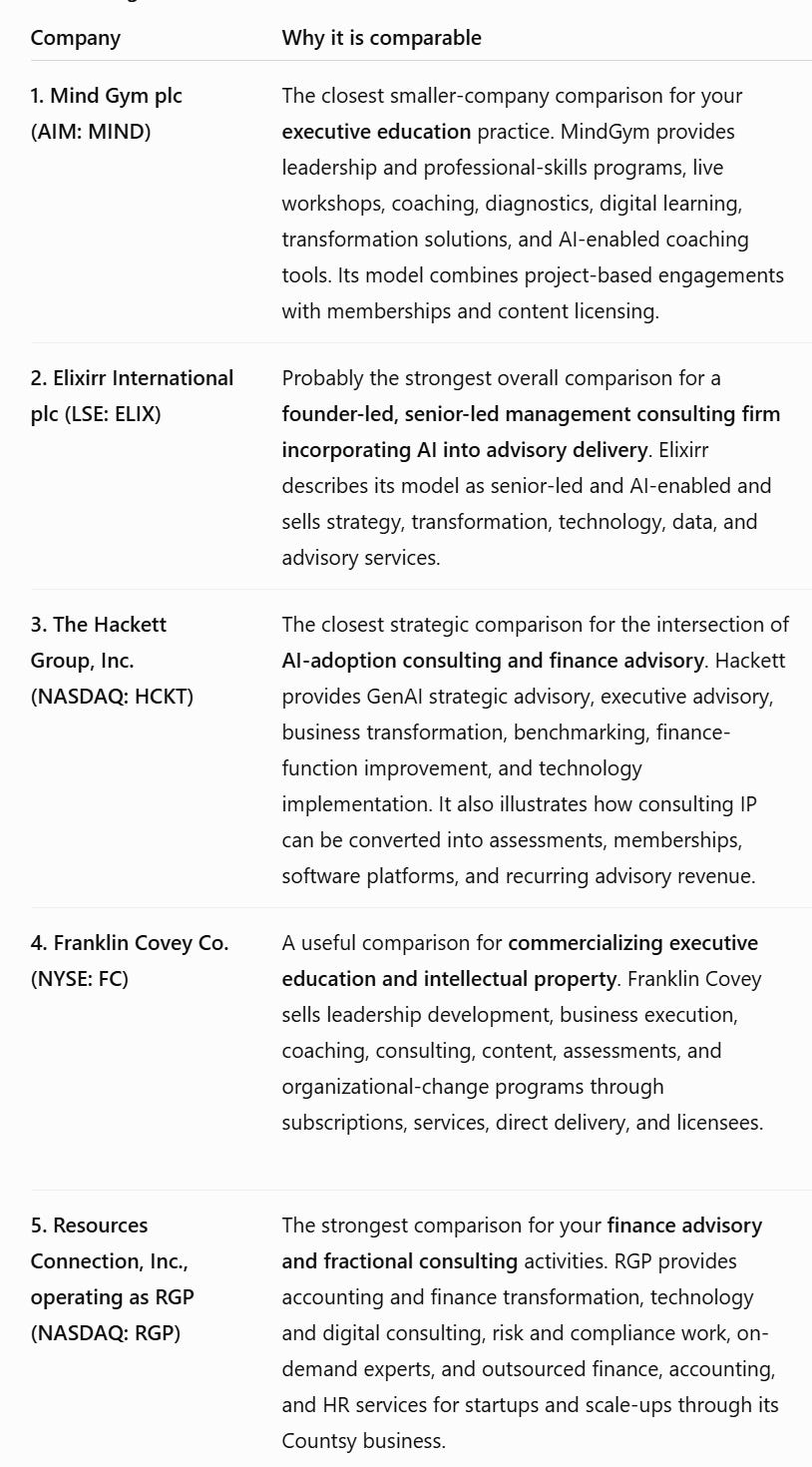
Begin by asking AI to identify comparable companies with publicly available financial statements.
For example: “My company is a small management consulting firm with approximately $1 million in annual revenue, fewer than five employees, and two years of operating history. The company provides executive education, AI-adoption consulting, and finance advisory services. Identify five companies with similar business models that have publicly available financial statements or financial disclosures. Prioritize smaller and less complex companies where possible. Explain why each company is comparable and provide the source of its financial information.”
Deep-research functionality is generally preferable for this task because the model can investigate multiple sources, compare business models, and document its reasoning. Standard web search can also be effective for a simpler analysis.
Exact matches may not exist. The objective is to identify useful reference points for:
Financial statement structure
Revenue presentation
Expense classifications
Accounting policy disclosures
Risk disclosures
Management reporting practices
Once you have identified the strongest benchmarks, select approximately three companies and download their financial statements or annual reports as PDF files. Save them in the project folder that will contain the company’s financial records.
I used GPT-5.6 Sol for the initial comparable-company research, then used Claude Fable 5 for the document-intensive financial statement preparation described below. The results from GPT-5.6 were as follows:
Where Are You Now?
The next step is to assemble the company’s existing information.
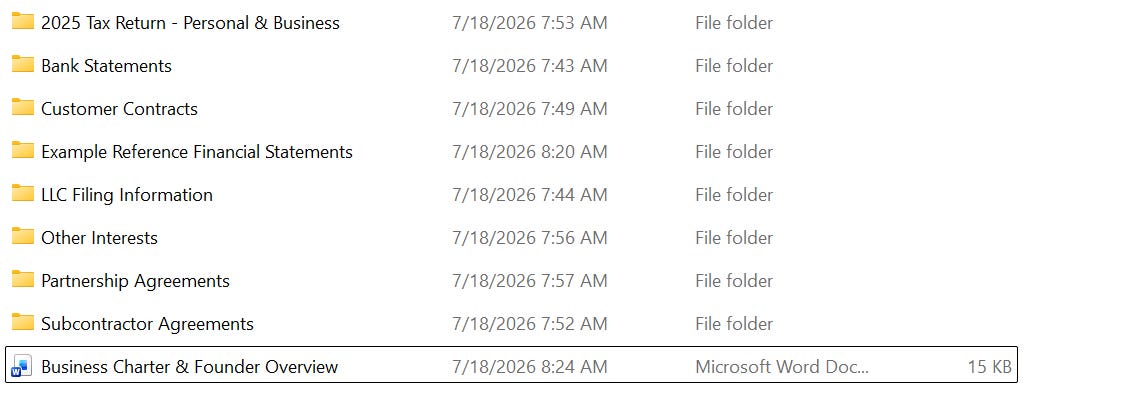
For a small business, the relevant records will commonly include bank statements, credit card statements, customer contracts, invoices, payroll reports, contractor payments, formation documents, tax filings, debt agreements, and ownership records. The company should also provide any existing accounting files, even if they are incomplete or inconsistent.
A short business-background memorandum should accompany these documents to give the AI sufficient context to interpret them accurately. The memorandum should describe the company’s history, ownership, leadership, business model, products and services, sources of revenue, major customers and vendors, employee and contractor compensation arrangements, financing structure, accounting policies, operational systems, and any unusual or significant transactions. It should also explain the founder’s relevant background, the company’s current stage of development, its primary business objectives, and any known accounting, tax, legal, or financial reporting issues that may affect the analysis.
This narrative is essential because accounting cannot be determined from transaction descriptions alone. A bank statement may show a $100,000 customer payment, but it does not reveal whether the amount represents revenue already earned, an advance payment for future services, reimbursement of expenses, or repayment of a loan. A legal invoice may relate to ordinary operations, a financing transaction, or the formation of the company. The accounting treatment depends on the underlying facts.
The company should also determine whether the source information is complete. All relevant bank and credit card accounts should be included. The reporting period should be fully covered. Beginning and ending balances should be available. Material contracts, financing arrangements, and equity transactions should be identified. AI can organize the information it receives, but it cannot reliably account for records that were never provided.
Once you complete the organization of this information, you should have a folder that includes the following:
How Do You Get There?
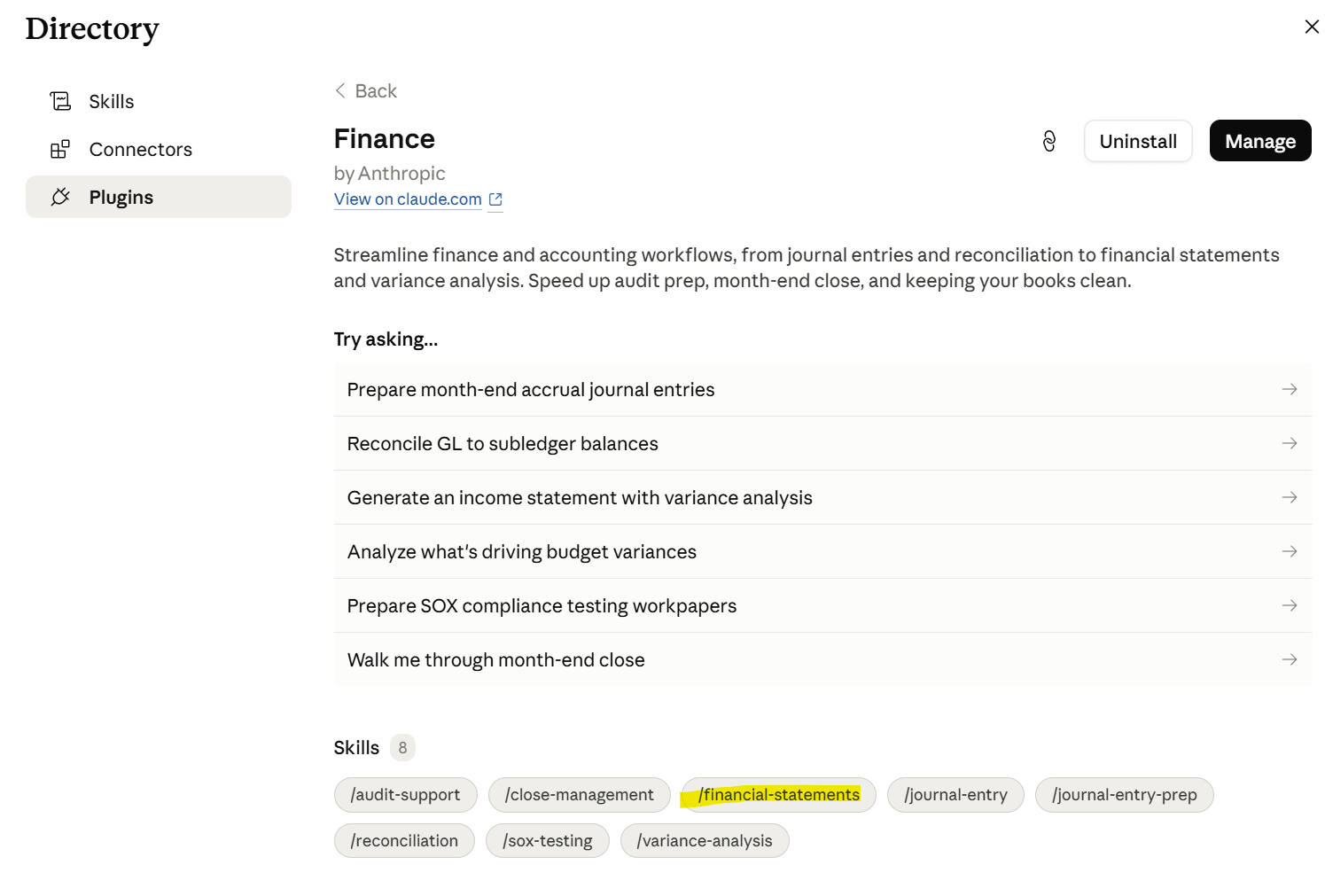
Once the company has defined the desired output and assembled the available information, it can begin the AI-assisted preparation process. For this workflow, I used Claude’s Fable model. Within Claude, I first directed the model to the folder containing all relevant information. I then confirmed that the appropriate skill was enabled and explained the organization of the folder, the available documents, and my desired outputs.
For this exercise, I used the Finance plugin and selected the “Financial Statements” skill, as highlighted below.
I then entered the following prompt. Because of its length, I have linked it here so you can review and use it yourself.
For work of this complexity, companies should generally use the strongest reasoning model available within their approved technology environment. The model must review multiple documents, connect information across sources, perform calculations, and distinguish routine classifications from areas requiring accounting judgment. Once the initial workflow has been completed and validated using the strongest model, future updates may be suitable for less resource-intensive models.
After submitting the prompt, you will receive a response outlining the proposed plan. At the time of writing, a workflow of this complexity may take anywhere from 5 to 30 minutes. While it runs, you can begin other workflows or continue working in separate conversations.
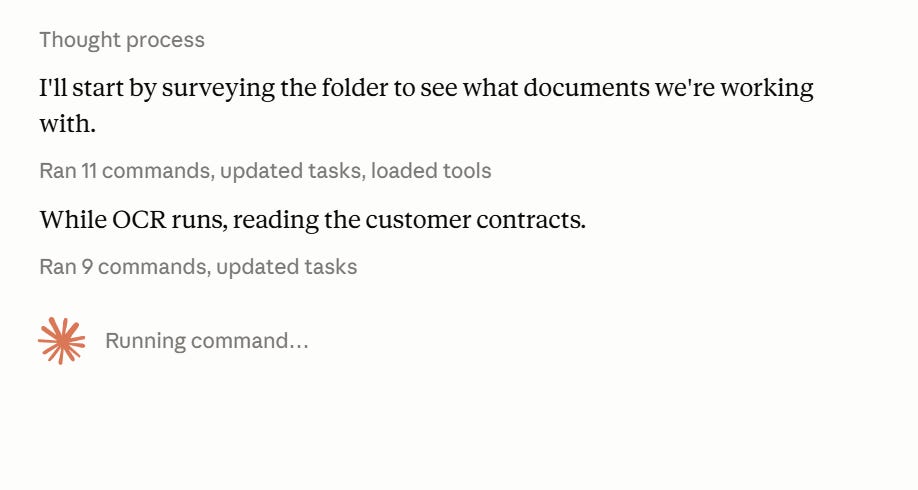
You can also periodically review the model’s plan and progress. In my case, the proposed plan aligned with my instructions, so I was comfortable allowing the process to continue.
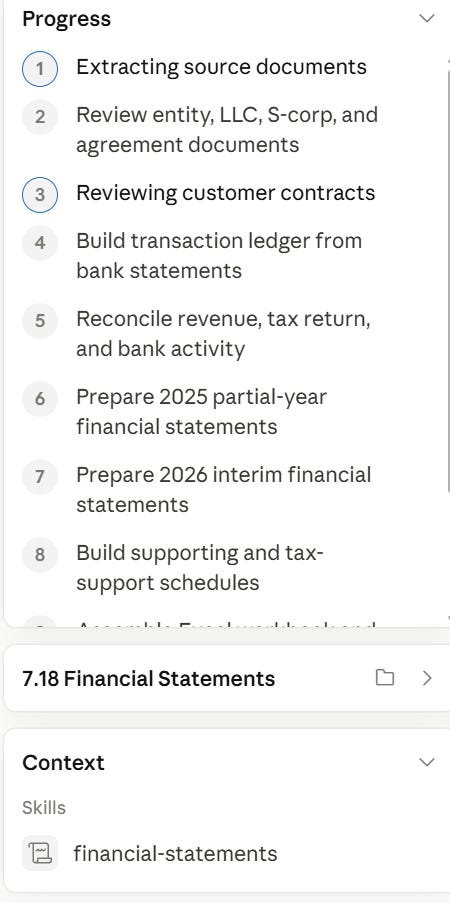
Once the workflow was complete, which took approximately 20 minutes in my case, I received three files:
A Word financial statement package
A PDF version of the financial statements
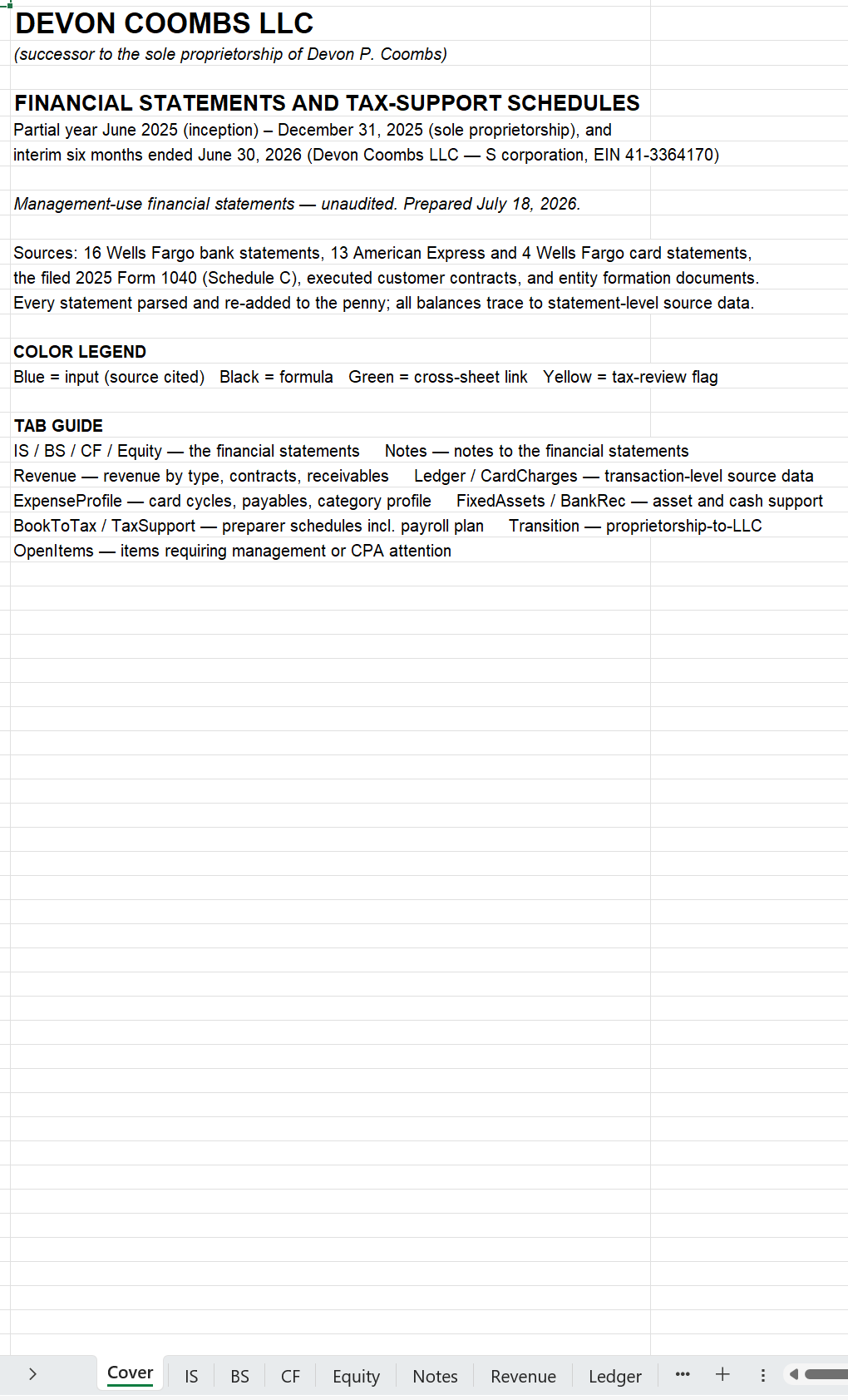
An Excel model containing the supporting schedules, formulas, and financial statement tie-outs
Screenshots of the model and financial statements are included below.
Excel Model: The Excel model included the balance sheet, income statement, statement of cash flows, statement of equity, revenue tie-outs, supporting schedules, and notes to the financial statements.
Example Income Statement: An example of the income statement produced within the financial statement package is shown below.
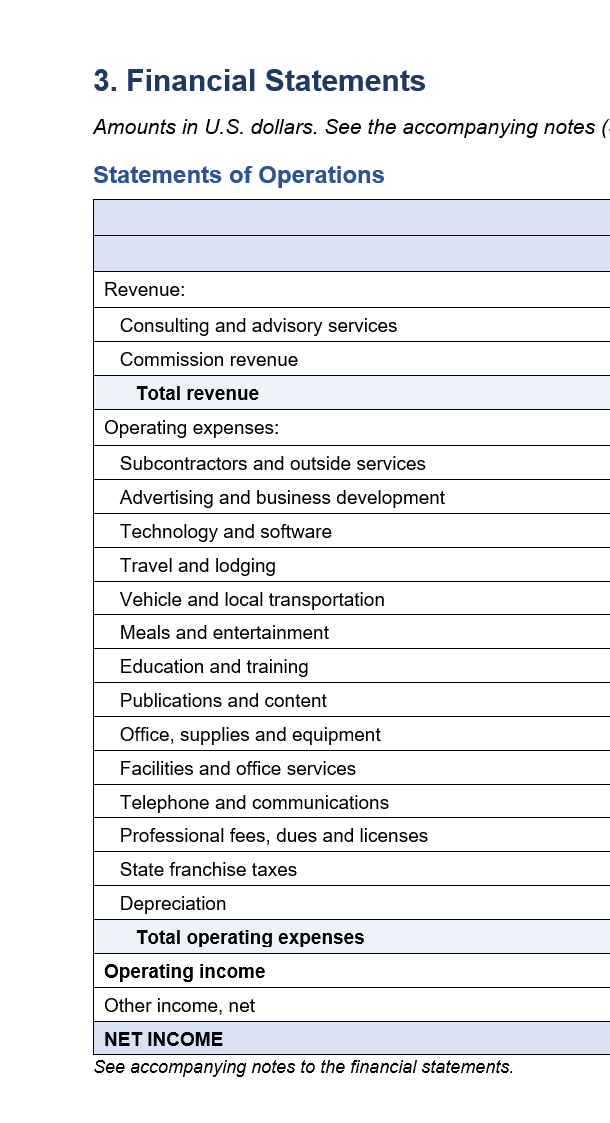
Based on my review as a CPA, the output was materially accurate and provided a strong starting point. Some additional judgment and adjustments were still required to finalize the numbers. The footnotes also needed further refinement.
However, the underlying detail was well organized, the supporting information was tied to the financial statements, and the source documents were referenced and attached. With several additional review passes and the application of professional judgment, the package could become a strong foundation for first-year audit preparation.
Enhancing the Excel Model
Once the underlying accounting has been reviewed, AI can also improve the structure and presentation of the financial workbook. Using ChatGPT or Claude within Excel, you can prompt the AI to standardize formatting and color schemes, verify that reconciliations are complete, and review the information contained in the underlying schedules and tables.

However, when I reviewed my workbook, I was impressed that most of this work had already been completed using the Fable model on its maximum setting. The workbook required few, if any, additional updates. Lower-tier models may require more cleanup, but I was pleasantly surprised by Fable’s accuracy, completeness, and formatting.
Useful instructions to include in the prompt are:
Apply standardized color coding to distinguish linked cells, formulas, and hardcoded values.
Trace each material financial statement balance to the trial balance, supporting schedule, and original source document.
Clearly label all assumptions, judgments, and estimates.
Document any changes made to the model.
Confirm that all financial statements and supporting schedules reconcile.
AI can assist with each of these tasks, but the instructions should emphasize auditability and traceability rather than appearance alone. A workbook that looks polished is not sufficient if a reviewer cannot understand where the numbers came from or how they were calculated.
The Result
At the end of the process, I received a well-organized and surprisingly complete financial reporting package.
The source documents were stored in a logical structure. The company’s activities and accounting assumptions were documented. Material balances were supported by schedules and reconciliations. The model also identified open questions for me to discuss with my tax accountant. In my case, those issues were already on my radar, but this would have been especially valuable for a company that had not yet engaged an accountant.
The final output should still be reviewed by a qualified accountant or tax professional before it is used for tax filings, audits, lending, investor reporting, or other formal purposes. AI-generated financial statements should not be treated as authoritative simply because they look polished.
Even with that limitation, the process easily saved me a week of work using my own financial information.
That is the real value of this technology. It creates a much stronger starting point.
Instead of handing an accountant a disorganized collection of bank statements, contracts, and spreadsheets, a company can provide a structured package containing preliminary financial statements, supporting schedules, documented assumptions, source references, and a clear list of unresolved issues. This can reduce professional fees, shorten reporting timelines, and allow accountants to focus on the areas where their expertise adds the most value.
More importantly, the process gives management access to reliable financial information earlier in the life of the company. That information can then be used to manage cash, evaluate profitability, forecast performance, raise capital, and make better business decisions.
The broader lesson is that AI is not valuable simply because it can produce financial statements. It is valuable because it can help transform fragmented records into a financial system that management can understand and use.
Last Thoughts
For the live course, I am developing a set of dummy financial data that students can use to test this workflow. Once the dummy data is complete, I will share it so people can test the workflow. However, I also realized that people could test the process using their own personal financial information, which may be even more useful.
Depending on the platform, account type, and privacy settings, you could upload your own bank statements, investment reports, and credit card statements to analyze your spending, assets, liabilities, and cash flow. You may identify subscriptions to cancel, unusual charges to investigate, or broader trends in your personal finances that are difficult to see across separate accounts.
Before uploading anything, carefully review the provider’s privacy, security, and data-retention policies. Use appropriate privacy settings or an approved enterprise environment, and avoid uploading sensitive information to unsecured or untrusted platforms. When possible, remove or redact Social Security numbers, complete account numbers, login credentials, and other information that is unnecessary for the analysis. You are responsible for determining whether a tool is appropriate for your personal or company data.
I hope you found this helpful. Please let me know which use cases you would like me to cover through future step-by-step walkthroughs.
Next week, I plan to cover flux analysis and accelerated close reporting. The following week, I will focus on benchmarking, peer analysis, and using financial statements to support market research and business decision-making.