
How does the founder shape the financial reality of a startup?
The Founder Is a Startup's First Asset

Hello all,
I took a brief pause from the weekly newsletter while preparing for the courses I will be teaching at Santa Clara University this fall. One course I am especially excited to teach is Entrepreneurial Finance. As I have been building the course, I realized that much of my research, class notes, and frameworks may be useful beyond the classroom, especially for those of you who are founders, work with founders, invest in startups, or advise entrepreneurs.
I also want to use this series to illustrate something I often write about: how AI can be used effectively to solve real problems. I am building complete online companions for my courses on my own website, using AI heavily to support the back-end code, front-end design, content organization, and editing process. I still provide the judgment, structure, subject-matter expertise, and final review, but AI helps me move much faster from idea to useful product.
That is how I try to teach AI as well: not as the product itself, but as a way to build better products. And by “product,” I simply mean a solution that helps people.
The online course companions are currently free to everyone. I recently completed my Real Estate Finance module, which you can view here: https://course.devoncoombs.com/real-estate-finance. Next up is my Entrepreneurial Finance module, beginning with the first lesson below.
I would welcome your thoughts. In particular, I would be interested in whether you find the framework useful, whether you would like to learn more about how I build these online modules, or whether you think I missed any relevant research or misapplied any of it in developing my own proprietary framework.
The Founder Is a Startup’s First Asset
Entrepreneurial finance is often taught as if the founder is secondary to the business model. Students learn how to estimate startup costs, build forecasts, value companies, raise capital, evaluate dilution, and plan exits. Those tools are important, but can be misused if we apply them before understanding the people who are building the company.
The same financial advice can be excellent for one founder and harmful for another. A growth-oriented founder with deep domain expertise and limited capital may need investor materials, customer traction, and a clear fundraising path. A lifestyle-oriented founder with substantial savings and no desire to scale may need the opposite advice: avoid overbuilding, protect autonomy, and design a business that supports the life they want. A novice founder with money may need to slow down before deploying capital. An expert founder with limited savings may need cash-flow discipline before pursuing growth. The technical finance answer changes because the founder’s position changes.
This module begins with founder diagnosis because finance is not just about money. It is about matching resources to strategy. Founders differ in financial capital, domain experience, goals, risk perception, personality, social capital, business-building skill, and stage of venture development. These differences shape what capital they need, what risks they underestimate, what advice they are likely to resist, and what kind of business they are actually trying to build.
The research behind this module points to several practical lessons:
Founders often face a tradeoff between wealth and control.
Many successful ventures begin with limited resources rather than large amounts of outside funding.
Expert entrepreneurs often reason from available means rather than targeted goals.
Technical skill does not automatically translate into business-building skill.
The founders’ personalities impact business and execution success.
Networks can expand or limit a founder’s real options.
Taken together, these findings lead to a simple conclusion: before advising the business, we need to understand the founder. Entrepreneurial finance is not only about whether a venture can raise capital or generate returns. It is also about whether the financing strategy fits the founder’s resources, goals, constraints, and capabilities.
My synthesis of this research, which I call the Founder Archetype Matrix, gives us a practical way to make that diagnosis. It does not predict success, rank founders, or replace market analysis. Instead, it helps students ask better questions before giving advice. Who is this founder? What do they already have? What do they lack? What are they trying to achieve? What risks are they likely to miss? What kind of capital, support, discipline, or restraint would actually help?
That is why this course starts here. Before we build forecasts, discuss valuation, or evaluate financing options, we first learn how to understand the entrepreneur. Good entrepreneurial finance advice is not generic. It is matched to the founder.
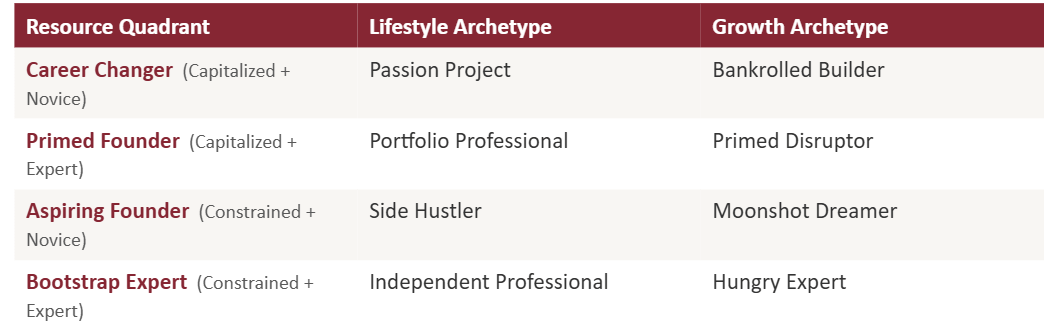
The Eight Archetypes at a Glance
Keep this card handy while reading. Each resource quadrant splits into a lifestyle archetype and a growth archetype, covered in full later.
The Matrix Integrates Seven Research Traditions
The Founder Archetype Matrix is not a single theory. It synthesizes seven bodies of research, each contributing one dimension or modifier to the diagnosis. Each section below states what the researcher found and how that finding maps into the matrix.
These sources differ in evidence quality. Some, such as Zhao and Seibert’s meta-analysis, are empirical. Others, such as Gerber’s E-Myth, are practitioner heuristics. This module notes which is which, and treats heuristics as illustrations rather than measured findings.
Founders Choose Between Wealth and Control (Wasserman, 2012)
Noam Wasserman in The Founder’s Dilemma analyzed data from roughly 10,000 founders and found that most face a recurring tradeoff. They can optimize for wealth, which he labels Rich, or for control, which he labels King. Founders who bring in co-founders, investors, and professional managers tend to build more valuable companies, but they cede control. Founders who retain control tend to build less valuable companies. Wasserman found that trying to maximize both at once is the most common path to achieving neither.
This fundamental tension requires founders to make “rich” versus “king” trade-offs to maximize either their wealth or their control over the company. Founders seeking to remain in control (as John Gabbert of the furniture retailer Room & Board has done) would do well to restrict themselves to businesses where large amounts of capital aren’t required and where they already have the skills and contacts they need. They may also want to wait until late in their careers, after they have developed broader management skills, before setting up shop. Entrepreneurs who focus on wealth, such as Jim Triandiflou, who founded Ockham Technologies, can make the leap sooner because they won’t mind taking money from investors or depending on executives to manage their ventures. Such founders will often bring in new CEOs themselves and be more likely to work with their boards to develop new, post-succession roles for themselves. Choosing between money and power allows entrepreneurs to come to grips with what success means to them. Founders who want to manage empires will not believe they are successes if they lose control, even if they end up rich. Conversely, founders who understand that their goal is to amass wealth will not view themselves as failures when they step down from the top job.
Craftsmen Practice a Trade; Opportunists Build an Organization (Smith, 1967)
Norman R. Smith produced one of the first formal entrepreneur typologies in The Entrepreneur and His Firm: The Relationship between Type of Man and Type of Company. The Craftsman-Entrepreneur tends to be focused on the present and past, has specialized technical education, and has low levels of confidence and flexibility. Conversely, the Opportunistic-Entrepreneur tends to have advanced education and social awareness, a high degree of flexibility, and an orientation to the future. The study implies that especially because the Opportunistic-Entrepreneur is flexible to change and oriented to the future, she will be most effective in making decisions that encourage innovation. The results of the study therefore support the hypothesis that an adaptable firm led by an Opportunistic-Entrepreneur will see the highest growth rate in terms of sales.
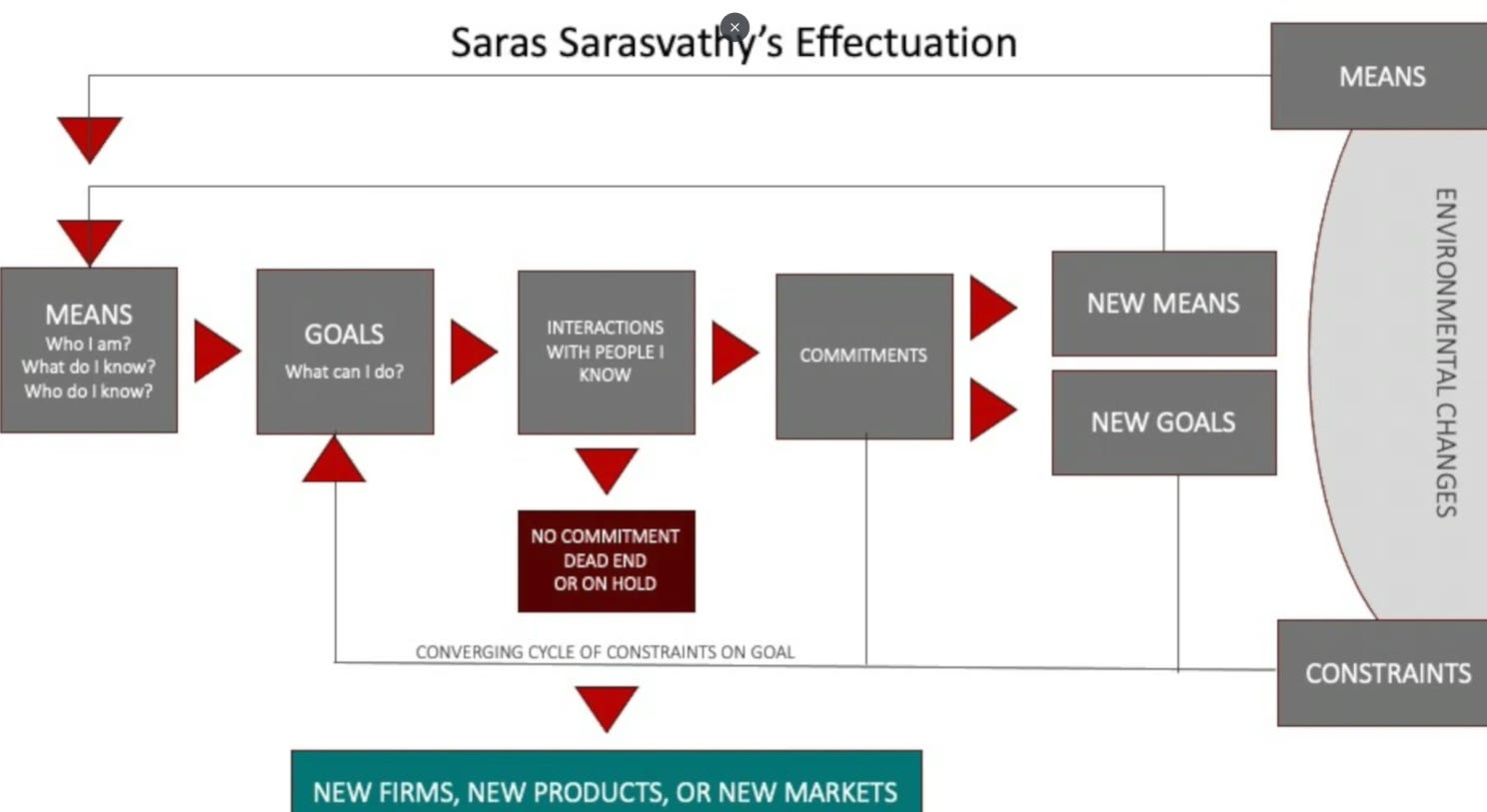
Expert Founders Start From Means, Not Goals (Sarasvathy, 2001)
In Causation And Effectuation: Toward a Theoretical Shift from Economic Investability to Entrepreneurial Contingency, Saras Sarasvathy studied how expert entrepreneurs reason. She found that they do not start with a fixed goal and work backward, which she calls causation logic. Instead, they start from their available means, namely who they are in traits and abilities, what they know through education and expertise, and whom they know through networks. They commit only what they can afford to lose, the affordable loss principle, rather than calculating an expected return.
Most Successful Ventures Start Resource-Constrained (Bhide, 1999)
Amar Bhide, in The Origin and Evolution of New Businesses, studied the founders of Inc. 500 companies and found that more than 80% bootstrapped with modest personal funds, with median startup capital around $10,000. Only about 5% raised initial equity from venture capitalists. Most of these businesses began with humble, improvised origins and relied on opportunistic adaptation rather than systematic planning. Bhide demonstrates that rapid adaptability, bootstrapping, and navigating early-stage ambiguity are far more critical to entrepreneurial success than massive initial funding.
The biggest findings from Bhidé’s research include:
The Myth of the Well-Funded Start-up: Highly planned, venture capital-backed start-ups are the exception, not the rule. Most successful entrepreneurs (such as the founders of Microsoft) start with minimal capital, improvised ideas, and zero formal market research.
Opportunistic Adaptation over Foresight: Instead of relying on breakthrough technologies or genius foresight, successful founders excel at face-to-face selling, making do with second-tier resources, and pivoting rapidly in response to early market feedback.
The “Local Maxima” Trap: Extrapolating a scrappy, improvised start-up approach indefinitely often leads to failure. To transform into a large, noteworthy enterprise, founders must radically shift from opportunistic niches to highly structured, ambitious, and long-term strategies.
Start-ups vs. Corporations: Established companies and scrappy start-ups play complementary rather than overlapping roles in the economy. While start-ups are superior at discovering and exploiting initial niches, large corporations have an irreversible advantage when it comes to capital-intensive initiatives, massive scale, and coordination.
Technical Skill Is Not Business Skill (Gerber, 1995)
Michael Gerber, in The E-Myth Revisited, argues that most small businesses are started by technicians who experience what he calls an entrepreneurial seizure. They are skilled at doing the work but have no training in running a business. Gerber describes the typical small business owner as roughly 10% Entrepreneur, 20% Manager, and 70% Technician. These figures are a practitioner heuristic, not a measured statistic, so treat them as an illustration of the gap. The business struggles because the founder confuses technical competence with business competence.
Key takeaways include the following:
The “E-Myth” (Entrepreneurial Myth): The false assumption that most small businesses are started by true entrepreneurs. In reality, they are started by “technicians” (people skilled at a craft) who experience an “entrepreneurial seizure,” quit their jobs to work for themselves, and inadvertently create an exhausting job instead of a true business.
The Three Personalities: Every business owner essentially acts as three people:
The Franchise Prototype: Businesses should be designed and systematized from day one as if they are to be replicated as a nationwide franchise. This ensures the business runs on reliable systems operated by “ordinary people” to achieve extraordinary results, rather than relying solely on “extraordinary experts”.
Personality Differences Are Real but Moderate (Zhao & Seibert, 2006)
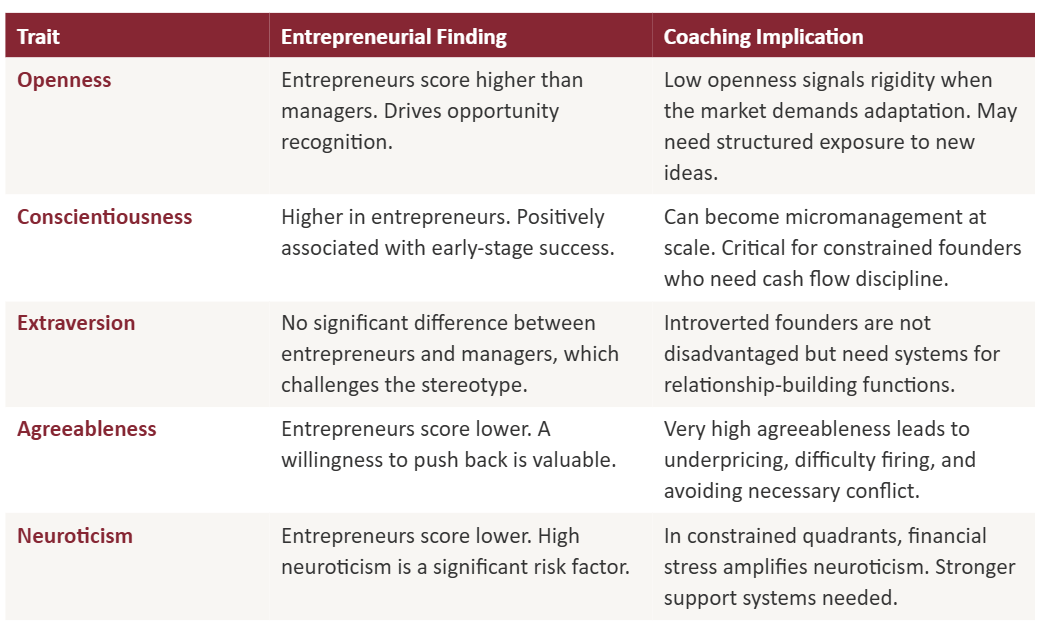
In The Big Five Personality Dimensions and Entrepreneurial Status: A Meta-analytical Review, Zhao and Seibert’s meta-analysis found that entrepreneurs differ from managers on several Big Five dimensions. Entrepreneurs scored higher on conscientiousness and openness to experience and lower on neuroticism and agreeableness. There was no significant difference on extraversion, which challenges the stereotype of the extroverted entrepreneur. The combined relationship across all five traits was moderate, with a multivariate correlation of R = .37.
Key takeaways, include that, compared to corporate managers, entrepreneurs score differently on four distinct pillars:
Higher Conscientiousness: Entrepreneurs possess a significantly stronger drive for achievement, dependability, and hard work. This trait showed the largest individual difference between the two groups (d = 0.45).
Higher Openness to Experience: Entrepreneurs score much higher in intellectual curiosity, creativity, and a preference for novelty. This fosters the innovation required to launch new ventures.
Lower Neuroticism (Higher Emotional Stability): Entrepreneurs are better at managing stress, anxiety, and the extreme uncertainties that come with self-employment.
Lower Agreeableness: Entrepreneurs score lower on compliance and consensus-seeking. They prioritize getting things done and driving their vision forward over maintaining immediate interpersonal harmony.
No Difference in Extraversion: Surprisingly, the study found no statistically significant difference in overall Extraversion between entrepreneurs and managers. Both professions require high levels of social interaction and assertiveness, neutralizing any clear gap.
To explain why these differences exist, the study adapted Benjamin Schneider’s Attraction–Selection–Attrition (ASA) model:
Attraction: People with high openness and low neuroticism are naturally drawn to the autonomy and risk of entrepreneurship.
Selection: Outside stakeholders (such as venture capitalists and suppliers) are more likely to fund and support individuals who display high conscientiousness.
Attrition: Individuals who lack emotional resilience (high neuroticism) or focus find the lifestyle deeply unsatisfying and leave the entrepreneurial space to return to traditional employment.
Founders Often Perceive Less Risk Than They Tolerate (Simon, Houghton & Aquino, 2000)
In Cognitive Biases, Risk Perception, and Venture Formation, research on entrepreneurial cognition distinguishes risk tolerance from risk perception. Simon, Houghton, and Aquino (2000) studied MBA students deciding whether to start a venture and found that cognitive biases, including overconfidence, the illusion of control, and the belief in the law of small numbers, lead people to perceive less risk, which in turn makes them more willing to start. In their account, entrepreneurs do not necessarily tolerate more risk. They often see less of it. The framework draws a practical corollary, that deep domain expertise can also lower perceived risk, although expertise and bias are different sources and only expertise tracks reality.
Key takeaways include:
The Risk Perception Gap: The decision to launch a venture is fully mediated by how founders perceive risk. Entrepreneurs generally do not have a higher willingness to take risks than others; instead, they simply perceive less risk in the venture than they are willing to accept.
Three Contributing Biases: The authors identify three key cognitive shortcuts that significantly lower an individual’s perception of risk:
Implication for Venture Formation: These heuristics unconsciously simplify information processing and allow founders to proceed with startups. By discounting the negative outcomes and uncertainties, founders evaluate the entrepreneurial opportunity positively and confidently proceed with new venture creation.
Three Distinct Dimensions Determine Coaching Strategy
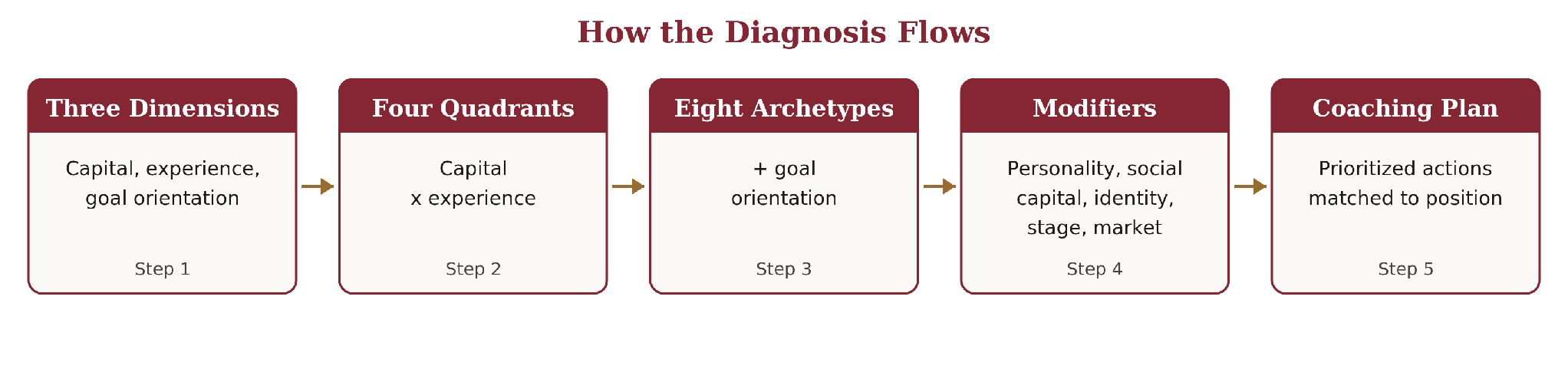
If we distill the above research into a few dimensions, we can develop a framework to assess founders. The seven bodies of research provide the theoretical and empirical grounding, while the three dimensions (Financial Capital, Domain Experience, Goal Orientation) translate those findings into a diagnostic tool. Instead of asking a founder to take a personality test or measure their cognitive biases, a coach or advisor can evaluate them on these three observable scales.
Here is exactly how the three framework dimensions map to the seven research traditions.
1. Financial Capital (Constrained vs. Capitalized)
This dimension measures a founder’s runway and risk exposure, drawing directly from research on how startups are actually funded and how founders calculate risk.
Bhidé (Bootstrapping): Maps directly to the finding that 80% of successful ventures start highly resource-constrained (median $10k), contrasting with the minority of well-capitalized, VC-backed startups.
Sarasvathy (Effectuation): Maps to the “affordable loss” principle. A constrained founder calculates what they can afford to lose, whereas a capitalized founder has different means and a different threshold for loss.
2. Domain Experience (Novice vs. Expert)
This dimension captures the founder’s existing knowledge and skills, distinguishing between technical capability and business acumen.
Gerber (The E-Myth): Gerber’s “Technician” is an expert in the craft (the product/service) but typically a novice in management and system-building (the market/business).
Simon, Houghton & Aquino (Risk Perception): Explains why experts act differently. Deep domain expertise lowers perceived risk, allowing experienced founders to move forward confidently where novices might hesitate (or rely entirely on cognitive biases like overconfidence).
Sarasvathy (Effectuation): Expert founders start with “what they know” and “who they know.” A high score in domain experience means they have a massive head start in means-based reasoning.
Smith (Craftsmen vs. Opportunists): The “Craftsman” archetype relies heavily on specialized technical education and past experience.
3. Goal Orientation (Lifestyle vs. Growth)
This dimension measures what the founder ultimately wants out of the venture, defining their baseline for success.
Wasserman (Rich vs. King): This is the most direct one-to-one mapping in the framework. A “Lifestyle” orientation maps exactly to Wasserman’s “King” (optimizing for control, autonomy, and retaining decision-making power). A “Growth” orientation maps exactly to the “Rich” archetype (optimizing for company valuation, scaling, and bringing in outside resources).
Smith (Craftsmen vs. Opportunists): Maps to the “Opportunistic-Entrepreneur,” who is focused on the future, adaptable, and aims to build a scalable organization, versus the “Craftsman” who wants to practice a trade
What about Zhao & Seibert?
You might notice that Zhao & Seibert’s personality research (The Big Five) does not map cleanly to a single dimension. This is by design. Their findings on conscientiousness, openness, and emotional stability describe the baseline psychological profile of entrepreneurs as a whole group compared to corporate managers. It acts as a foundational layer underneath the matrix, rather than a variable you would use to decide between two different coaching strategies for two different founders.
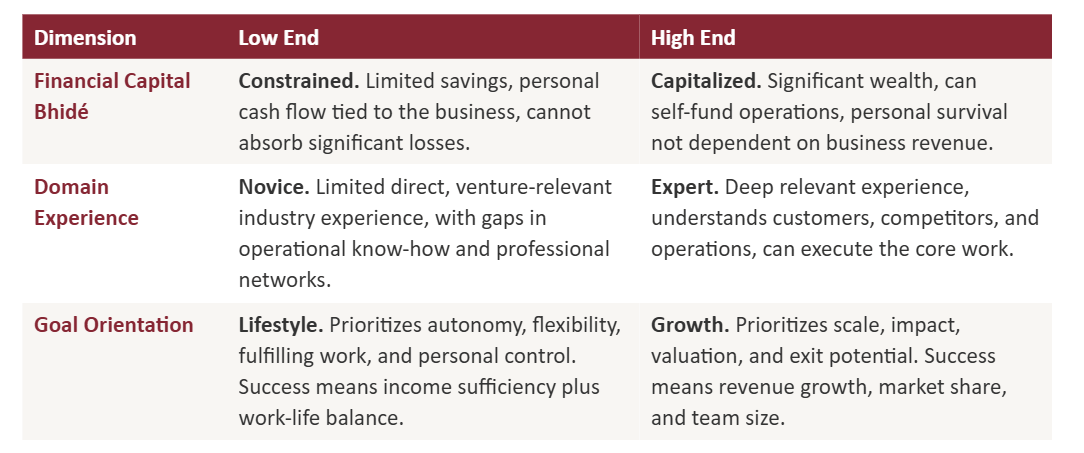
Assess domain experience relative to the venture’s specific industry and go-to-market, not the founder’s adjacent craft. A founder can be an expert at the product and a novice at the market, as the worked diagnosis later shows. Record that split rather than averaging it into a single score. Business-building skill, covered later as the E-Myth gap, is a separate capability again.
Capital and Experience Define Four Resource Profiles
The primary matrix maps financial capital against domain experience to produce four resource profiles. Goal orientation, the third dimension, splits each profile into two archetypes in the next section.
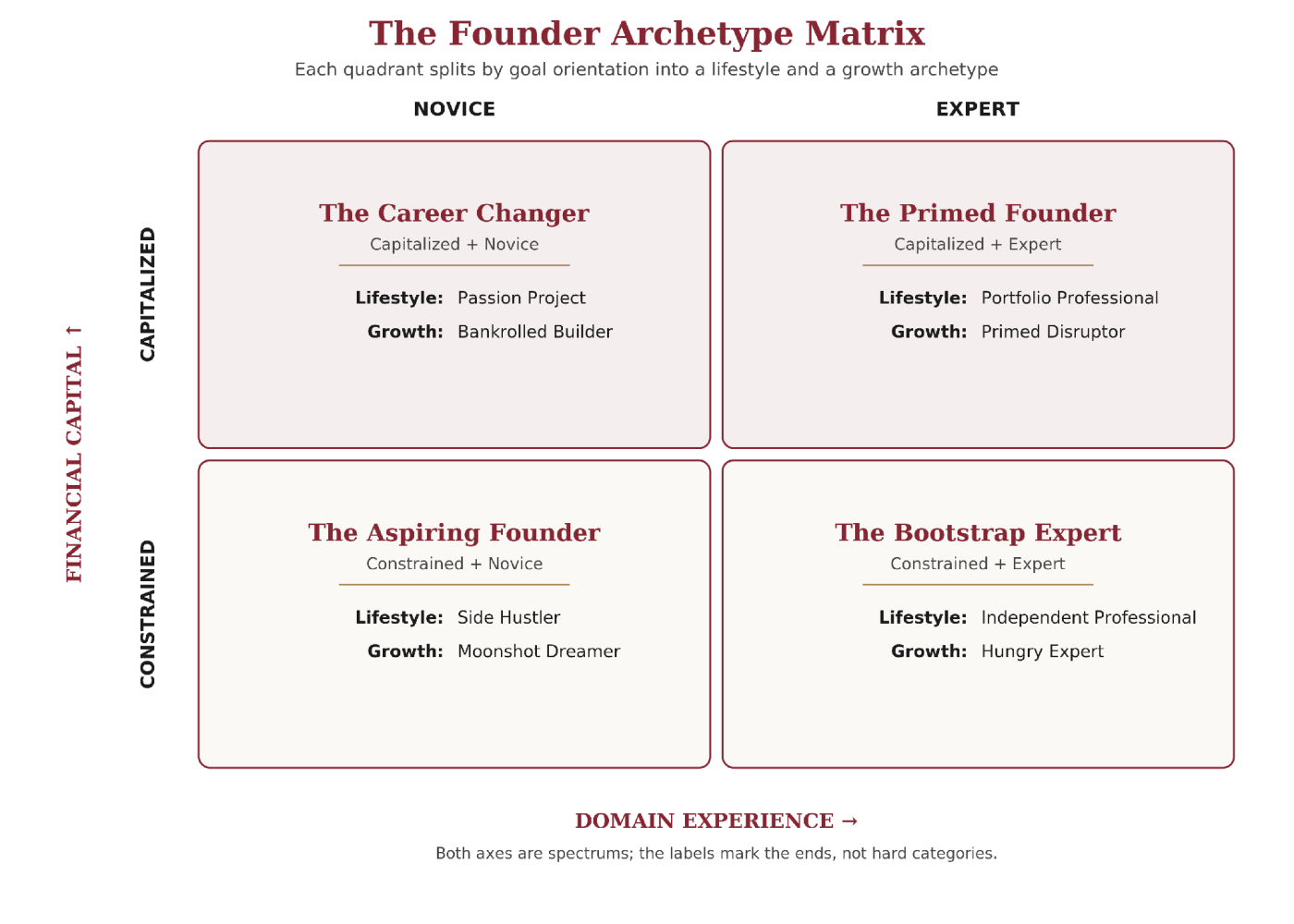
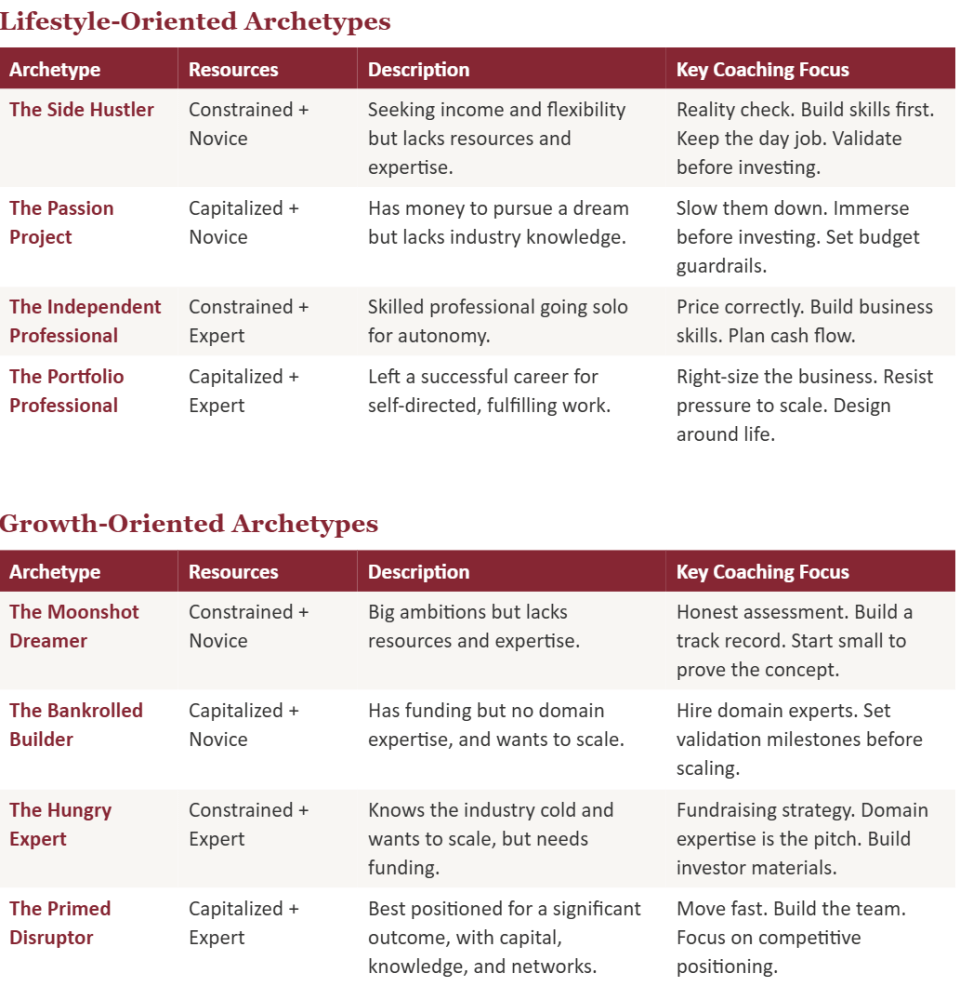
Goal Orientation Splits Each Quadrant Into Eight Archetypes
Crossing the four resource quadrants with the two goal orientations, lifestyle and growth, produces eight practical archetypes. Each carries a distinct coaching focus. The resource column shows the underlying quadrant.
Personality Predicts Execution Risk
Resource position and goal orientation tell you what advice to give. Personality tells you how to deliver it and where the founder will struggle to execute. The Big Five model, often abbreviated OCEAN, is the most validated tool for this layer. Read each trait for the entrepreneurial finding and the coaching implication, not as a verdict on whether someone should found a company.
Social Capital Can Shift a Founder’s Effective Position
Social capital does not appear as a standalone axis because it cuts across both resource dimensions. It is a modifier that can move a founder’s effective position within a quadrant. Two research findings anchor it.
Granovetter’s The Strength of Weak Ties (1973): Weak ties, meaning acquaintances and distant contacts, are often more valuable than strong ties for reaching new information and opportunities. A broad, diverse network can be more strategically valuable than a tight inner circle.
The Job Hunt: Over half (54%) of the people found their jobs through personal contacts. However, of those who used contacts, 83.3% found their job through a weak tie (someone they saw occasionally or rarely). Only 16.7% found a job through a strong tie (a good friend).
Information Diffusion: Rumors, innovations, and new cultural trends spread rapidly through society because of weak ties. If a message only moves through strong ties, it quickly reaches everyone in a small clique and then dies out, because nobody in that clique has a connection to the outside world.
Social Cohesion: On a macro level, Granovetter argued that communities with few weak ties are highly fragmented and struggle to organize. Communities with abundant weak ties (even if they lack deep, strong friendships) are more cohesive and capable of mobilizing for political or social action.
Burt’s Structural Holes: The Social Structure of Competition (1992): People who bridge gaps between otherwise disconnected networks gain advantages in information, timing, and referrals. This is especially relevant for Career Changers and Bankrolled Builders, who hold strong networks in a previous industry but a structural hole between that network and their target industry.
Your Close Circle is an Echo Chamber: Because your close friends and immediate colleagues tend to know each other, they possess the exact same information you do. While strong ties provide high trust and emotional support, they are mathematically terrible for discovering new opportunities, ideas, or trends. If you want fresh information, you have to look outward to the edges of your network.
Acquaintances Are Strategic Assets: The people you see only occasionally, former coworkers, conference contacts, or friends of friends, are the “local bridges” to entirely different social worlds. Because they run in different circles, they hold the key to non-redundant information. When you need a breakthrough (like finding a new client, pivoting careers, or sourcing a novel idea), your weak ties are statistically your best bet.
Power Belongs to the Broker: Your competitive advantage isn’t determined by how many people you know, but by whether your contacts know each other. If you sit between two disconnected groups, acting as the bridge across a “structural hole”, you gain immense leverage. You get to control the flow of information, translate value between different domains (like linking corporate finance with tech startups), and see opportunities long before anyone trapped inside a single echo chamber does.
Strong social capital can partially compensate for gaps in financial capital or domain experience. Weak social capital is an additional risk factor. Address it deliberately through structured networking, industry association involvement, or advisory board construction.
Note: Network advantage depends on the value of the information and trust that flow through the ties, which the matrix does not measure. A large network of low-trust or low-relevance contacts can look strong and deliver little.
Two Growth Founders Can Share a Quadrant but Differ in Motivation (Fauchart & Gruber, 2011)
Fauchart and Gruber in Darwinians, Communitarians, and Missionaries: The Role of Founder Identity in Entrepreneurship, found that founders carry distinct social identities that shape their decisions. Two growth-oriented founders can look identical on the matrix and still behave very differently.
The Darwinian
Core Motivation: Economic self-interest, wealth accumulation, and competitive advantage.
Definition of Success: Being recognized as a “professional” and systematically outperforming industry rivals. They care deeply about market share and benchmarks.
Coaching Focus: Unit economics, valuation, and exit timing.
Primary Blind Spot: They are prone to short-termism, ruthless competitor obsession, and building high-churn company cultures. Coaches must often intervene on employee retention, empathy, and brand reputation.
The Communitarian
Core Motivation: Creating value for a specific, well-defined community (e.g., a rock climber building gear for other climbers).
Definition of Success: Authenticity and peer validation. They want to be seen as a true, embedded member of their target group.
Coaching Focus: Community engagement, authentic brand building, and sustainable business models.
Primary Blind Spot: The “Sell-Out” Trap. They often self-sabotage growth because scaling requires selling to “outsiders,” which feels like a betrayal of their core community. Coaches must help them scale without losing their authentic roots and learn to delegate to non-community members.
The Missionary
Core Motivation: Advancing a societal cause or solving a massive problem.
Definition of Success: Systemic change. They want to solve a problem so completely that their business ideally wouldn’t need to exist anymore.
Coaching Focus: Impact measurement, mission-aligned hiring, and sustainable funding.
Primary Blind Spot: Financial martyrdom. They are highly susceptible to ignoring unit economics, underpricing their product, and burning themselves out because “the cause is too important.” Coaches must drill in the reality that “no margin means no mission”, they must build a profitable machine to sustain their impact.
Coaching Note: While these are the base types, the most successful founders often possess hybrid identities. For example, a Darwinian-Missionary wants to aggressively dominate a market in order to fund and push humanity forward. Recognizing a hybrid helps you pull the exact right lever at the right time.
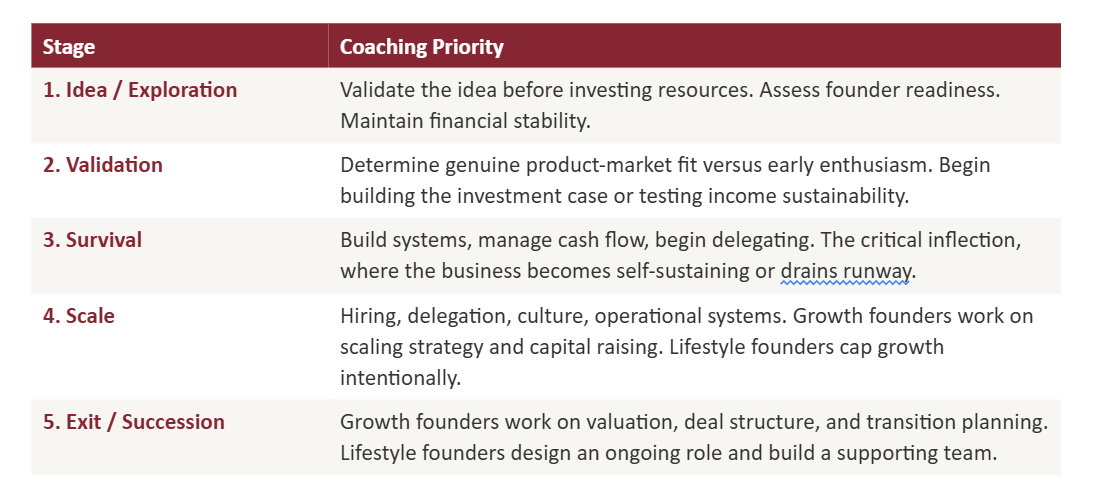
Coaching Priorities Shift With Venture Stage
A founder’s archetype does not change as the venture matures, but coaching priorities within the archetype do.
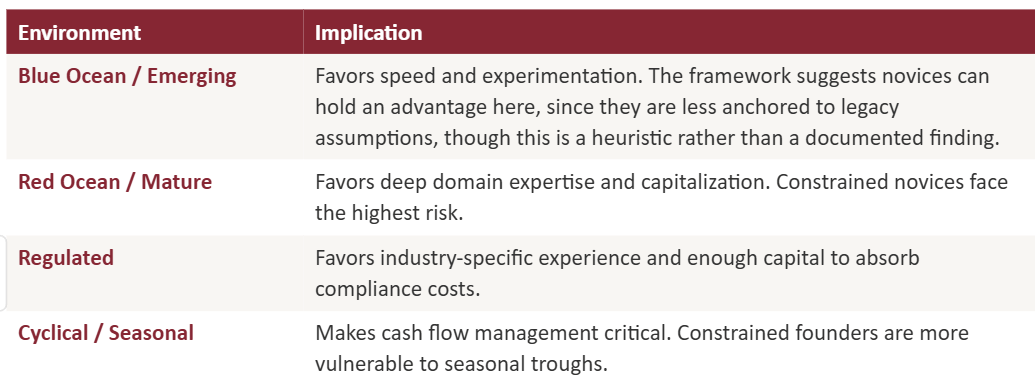
Market Conditions Change How Each Archetype Performs
The same archetype operates differently under different market conditions. A brief environment assessment should accompany the founder assessment.
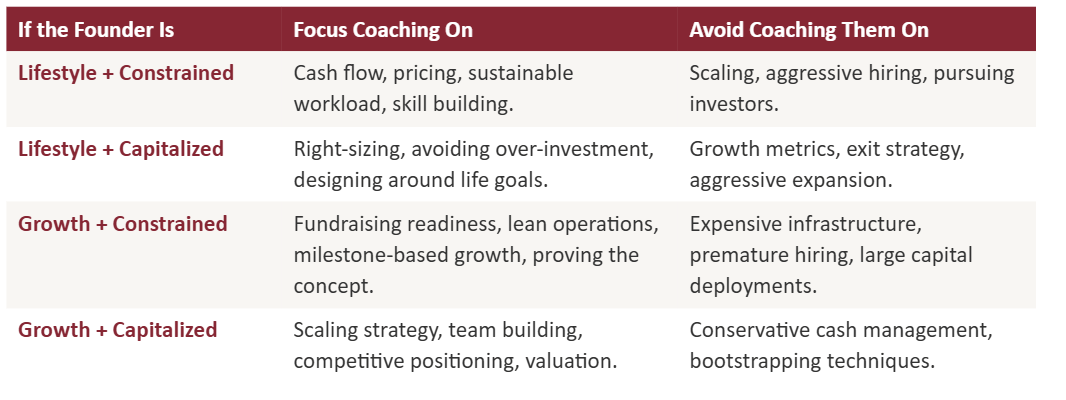
Coaching Quick Reference
Use this table to align the coaching approach to the founder’s position at a glance.
Four Limits on How Far the Matrix Reaches
People change over time. A Bootstrap Expert who builds a successful company becomes a Primed Founder for the next venture. Goal orientation shifts too. The matrix is a snapshot, not a permanent label. Reassess every 12 to 18 months.
The axes are spectrums, not binaries. Most founders fall somewhere along each dimension. The quadrant labels are useful shorthand, but coaching should be calibrated to the specific position.
Resource position is not destiny. In Bhide’s Inc. 500 sample, most successful businesses started with modest resources. Being constrained is the entrepreneurial norm, not a deficiency.
The matrix assesses the founder, not the opportunity. Market size, customer pain, competitive dynamics, and product-market fit require separate analysis. The matrix is a heuristic conversation tool, not a validated psychometric instrument, and a placement depends on the judgment of the person making it.
A Worked Diagnosis: Applying the Matrix End to End
This worked diagnosis applies every layer to one founder.
The case. Darius spent 15 years as a chef and most recently ran the kitchen of a well-regarded regional restaurant group. He has about $18,000 in personal savings and no outside funding. He wants to build a packaged pasta-sauce brand and sell it nationally through grocery retail chains within five to seven years. He knows ingredients, suppliers, and food cost cold. He has never raised money, built a consumer brand, or sold into retail. He is calm under pressure, highly organized, quick to try new recipes, and dislikes conflict. His network is dense among chefs, distributors, and suppliers, but he knows no grocery-chain category buyers.
Step 1: Place the founder on the three dimensions
Financial capital, Constrained. $18,000 in savings, no outside funding, and personal cash flow tied to the venture. He cannot absorb a large loss.
Domain experience, Expert on the product, novice on the market. He is an expert at making the sauce and managing food cost, so he can execute the core craft. He is a novice at packaged consumer goods and retail distribution. Assess domain experience relative to the venture’s actual industry, and record the product-versus-market split rather than averaging it away.
Goal orientation, Growth. National distribution and an exit within five to seven years is a scale-and-exit goal, not a lifestyle goal.
Step 2: Read the quadrant and the archetype
Constrained plus expert places Darius in the Bootstrap Expert quadrant. Adding growth orientation makes him a Hungry Expert. The archetype’s standard coaching focus is a fundraising strategy in which the founder’s domain expertise is the pitch. The product-versus-market split changes the order of operations, since his expertise is culinary, while the pitch a retail investor wants to see is proof of shelf demand.
Step 3: Read personality as execution risk
Darius is highly organized, which is high conscientiousness and supports the cash discipline a constrained founder needs, with a watch for micromanagement later. He is quick to try new recipes, which is high openness and aids adaptation. He is calm under pressure, which is low neuroticism and helps under financial stress. He dislikes conflict, which signals high agreeableness and predicts the most likely execution failure, underpricing and conceding margin in retail negotiations. Pre-empt it by setting margin floors before he sits across from a buyer.
Step 4: Separate perceived risk from tolerated risk
His culinary expertise lowers his perceived product risk, and because that expertise is real, the lower perception is partly earned. The same confidence does not transfer to retail go-to-market, where he is a novice and where overconfidence or an illusion of control could hide genuine risk, such as slotting fees, velocity requirements, and buyer power. Separate his earned confidence on the product from his untested confidence on the market.
Step 5: Apply the modifiers
Social capital. Strong ties among chefs, distributors, and suppliers, and a structural hole between that network and grocery category buyers. Bridge it deliberately through a food broker or an advisory board member who has sold into national retail.
E-Myth gap. Excellent at the craft and untested at brand building, retail sales, and finance. The gap is acute and should be closed by learning or hiring, not assumed away.
Founder identity. A national brand and a planned exit suggest a Darwinian identity, so coach unit economics, margins, and exit timing. Confirm the motivation with him rather than inferring it.
Stage and market. He is at Idea and Validation, and packaged sauces are a Red Ocean, mature, and partly regulated market. Mature markets reward expertise and capital, both of which he is short on for go-to-market, so a differentiated beachhead and a compliance budget matter more than speed.
Step 6: Translate the diagnosis into a coaching plan
Validate before raising. Prove retail demand in a regional beachhead, through local grocers, farmers markets, or direct-to-consumer, before pursuing national distribution or outside capital.
Bridge the structural hole. Use a broker or advisory board to reach category buyers, since his network does not.
Set margin floors. Decide the lowest acceptable wholesale margin in advance to counter the agreeableness-driven tendency to concede price.
Protect the runway. Avoid committing the $18,000 to national inventory or infrastructure before the beachhead validates demand.
Close the business-building gap. Learn or hire brand, retail sales, and finance, because culinary skill does not cover them.
Diagnosis Summary:
Hungry Expert, constrained and expert on the product but novice in retail, growth-oriented and likely Darwinian, with a structural hole to buyers and an acute E-Myth gap. Validate the market and bridge to buyers before raising capital or buying inventory.
Really enjoyed this. One thing that resonated with me is the idea that founders are often evaluated through the lens of the company rather than the other way around.
In my experience as a founder, I benefit most from advisors that understand our goals, constraints, and capabilities; while I want to do more than I am, where I am is where we gotta start. Advice to us right now should be very different than a Series A.
I'd be especially interested in seeing how the framework performs when applied to repeat founders versus first-time founders, and whether certain archetypes tend to evolve in predictable ways over time.